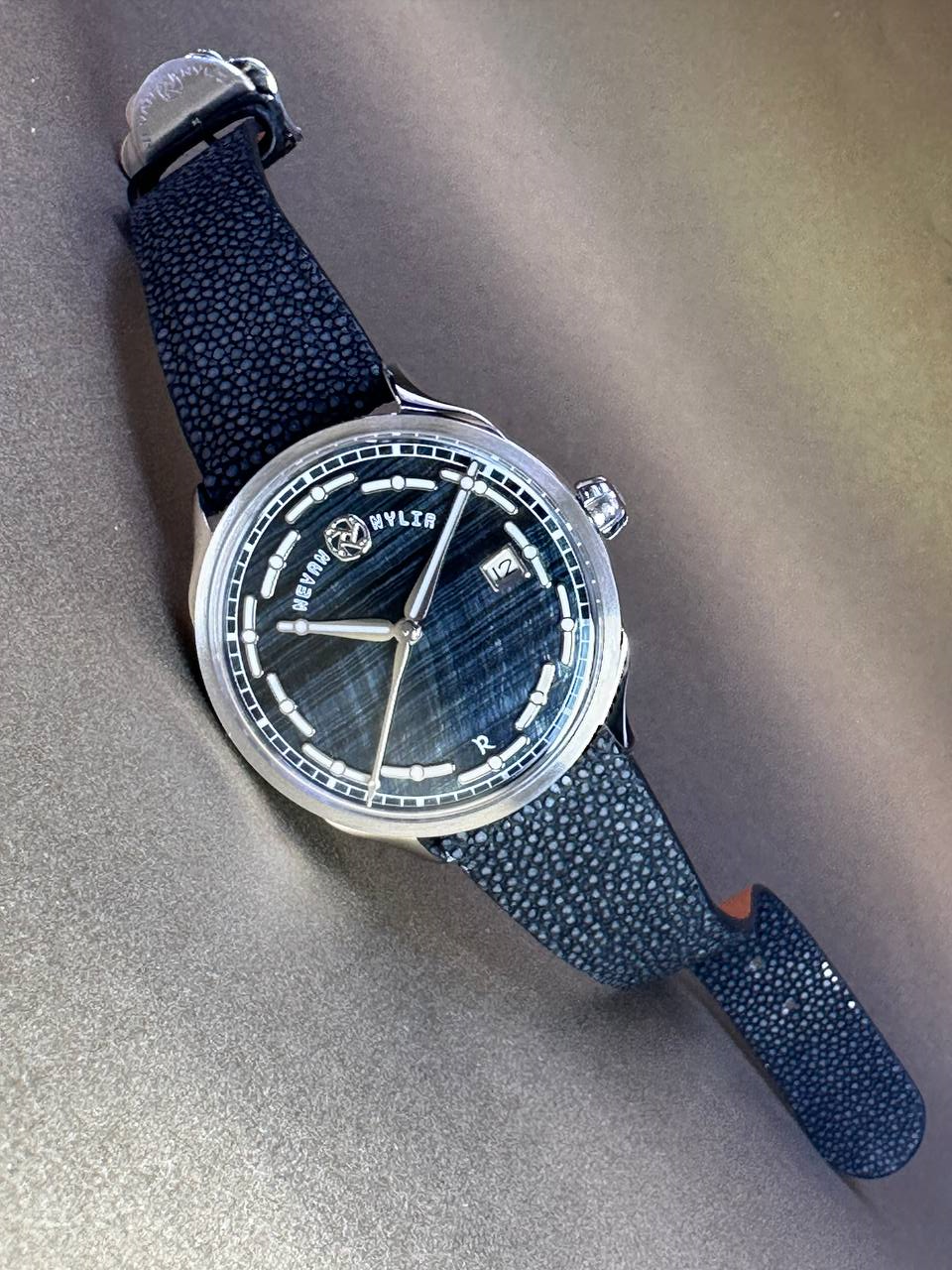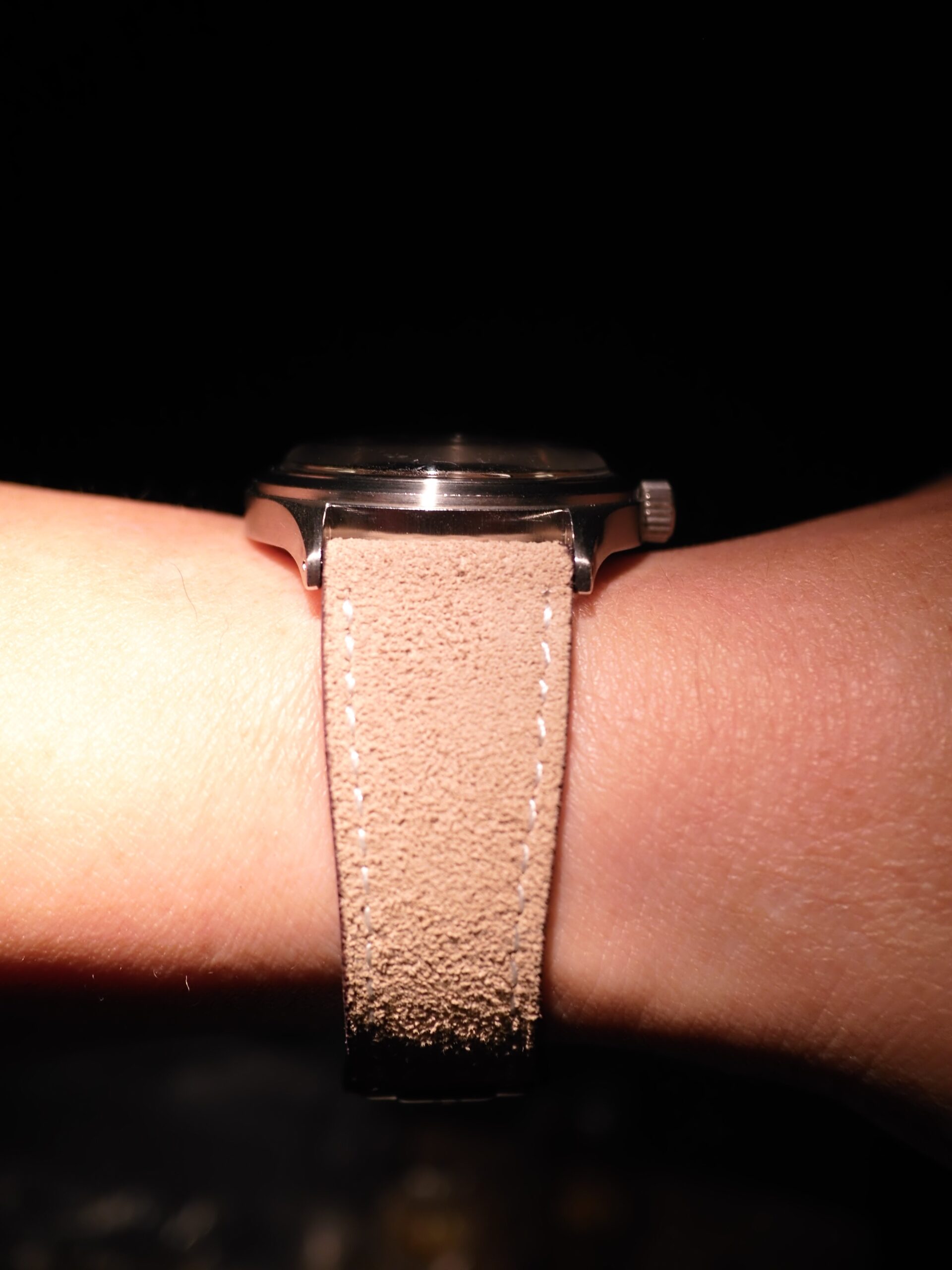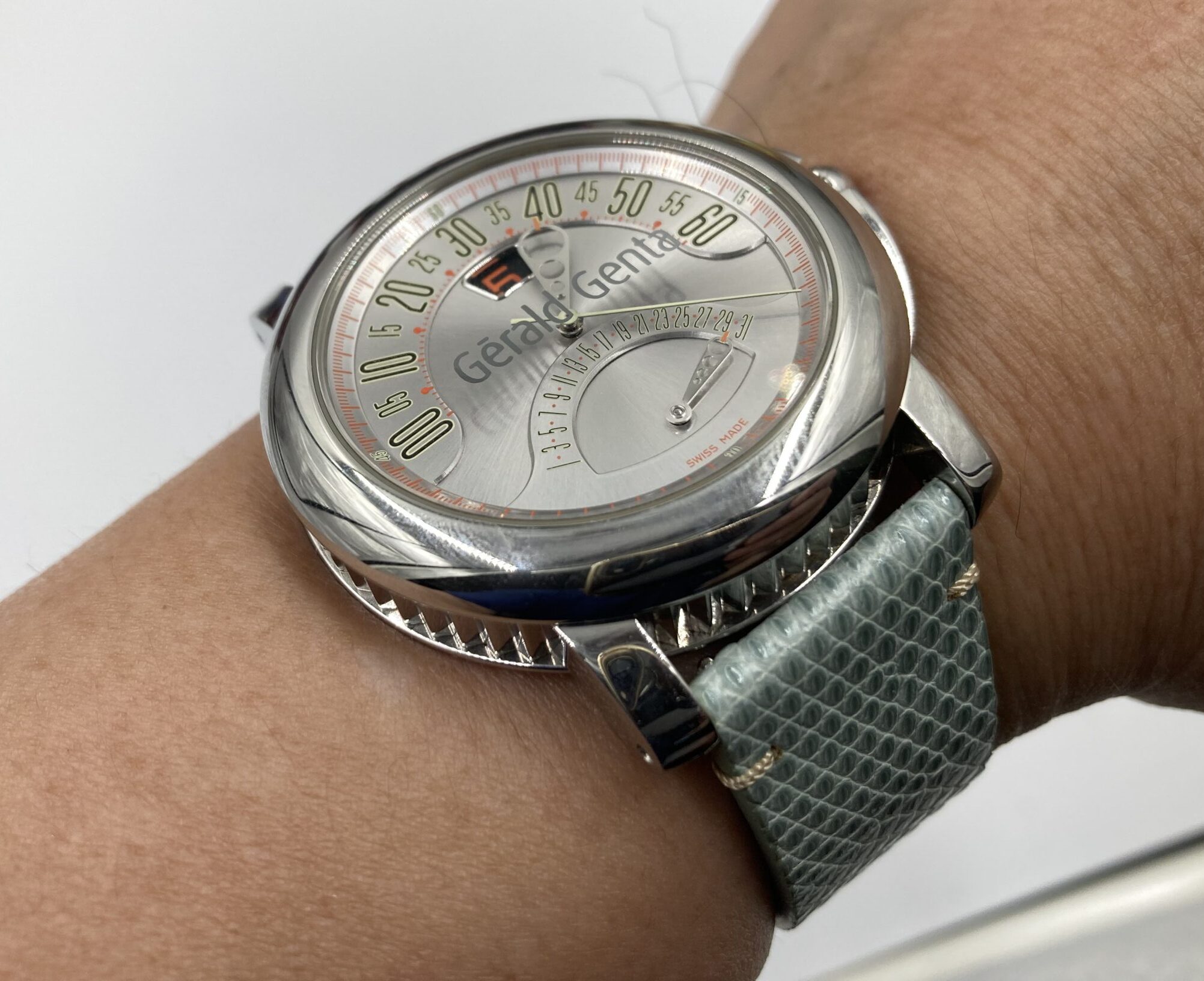
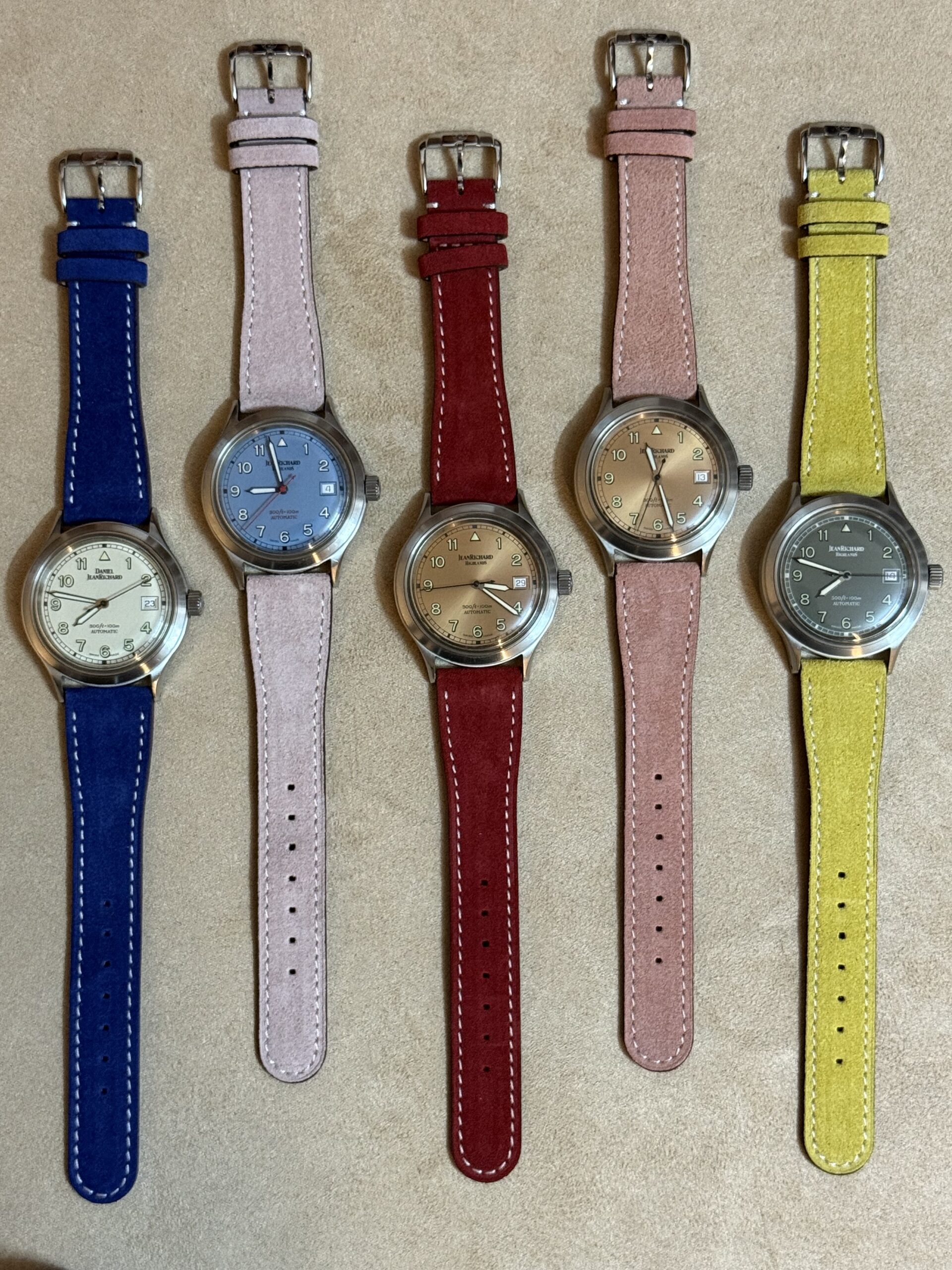
- Compatibility. There is no universal ‘one size fits all’ solution when it comes to pairing straps with watches. If you own an extra large sports watch, you’ll require a replacement strap with different measurements to, say, a vintage wristwatch with a far smaller case.
- Fit. In our experience, a timepiece should be tight enough not to slide more than an inch across your arm and loose enough not to leave an imprint.
- Style. Although choosing a strap is essentially a matter of personal preference, there are a few fundamental and timeless truths; a large wrist is – proportionally speaking – better suited to a wider strap, for example.
2 SIMPLE STEPS TO FIND YOUR STRAP SIZE

Step 1: Determine your lug width & buckle width (A and B)
To determine your width, you can take a ruler or caliper, and measure the width of the part of the strap that uses spring bars/screws to attach to your watch case. Measure this in millimetres. Width is expressed, for example like this: 20/16 mm (20 mm wide by 16 mm wide). This first number (20 mm) is the width of the strap between the lugs of the watch case (A). The second number (16 mm) is the width of the strap at the buckle (B). You just need to ensure that the first number (A) matches the lug width of your watch to use the straps.
A “straight” strap is one that is the same width at the lugs and the buckle, i.e. 24/24 (24mm wide at lugs by 24mm wide at buckle). While a “tapered” strap is one that tapers in width from the lugs to the buckle, i.e. 20/16 mm (20 mm wide at lugs by 16 mm wide at buckle).
If you don’t find the lug width of your watch below, and feel difficult to determine the lug width, please tell us the brand name, and model of your watches, or simply the pictures of your watches, and we will help you figure out.
Step 2: Determine your long strap length and short strap length (C and D)
There are two lengths required, the tail end (length of long section), and the buckle end (length of short section, excluding buckle). Length is expressed, for example like this: 115/75 mm. The first number (115) is the length in millimetres of the tail end with holes. The second number (75) is the length in millimetres of the buckle end.
a. Measure your current strap
If your existing strap fits comfortably around your wrist, then you’ve already found a suitable length. All you need to do is measure the tail side and buckle side straps separately using a ruler, remembering to exclude the buckle itself. The two dimensions will highlight the optimal length. You should look for a replacement strap with the same or a similar length. You should adjust accordingly if your current strap does not fit your wrist perfectly.
Another more complicated method can be used if you want to ensure that the total length based on where your buckle sits on your current strap, will be similar to your new strap. To do this, you will need an existing two-piece strap on your watch.
- Measure the length of the short piece of the strap. (Example: 80mm).
- On the long strap, measure the length from the lug to the most used strap hole. Referring to the schematic above, if the middle hole is the most used hole, that would be length E. (Example: 60mm).
- Sum the two lengths (80+60=140mm).
- Determine which hole on the strap you would prefer to have your buckle fitted on, and measure the length from the lug to the hole. If you like having a longer “tail”, you can have the buckle fitted on the top-most hole, closest to the lug end. Alternatively, if you prefer not to have a long “tail”, you can wear the strap with the buckle on the bottom-most hole, furthest from the lug end. (In this example, assume that I prefer to use the middle strap hole for M strap = 71mm).
- Subtract the length in Step 3, from the length of the lug to the most used hole. This is the “ideal length” of the short piece of the strap. (140mm-71mm=69mm).
b. Measure your wrist size
To determine your wrist length, you can simply wrap a piece of string/thread around your wrist at the point where you normally wear your watch, mark the string where it crosses itself, lay it flat on a table and measure the distance between the marks. This is your wrist size.
The table below is a great place to start for deciding your strap lengths. If you are between sizes, we recommend sizing up.
| Wrist Size | Strap Lengths |
| 100/60 mm | |
| 6″ +- 0.5″ (152 mm +- 12.5 mm) | 105/60 mm |
| 105/65 mm | |
| 110/65 mm | |
| 110/70 mm | |
| 115/70 mm | |
| 7″ +- 0.5″ (178 mm +- 12.5 mm) | 115/75 mm |
| 120/75 mm | |
| 120/80 mm | |
| 125/80 mm | |
| 125/85 mm | |
| 8″ +- 0.5″ (203 mm +- 12.5 mm) | 130/85 mm |
| 130/90 mm |
Note:
- Wrist Size – Strap Length correlation is based on a typical 40 mm diameter watch.
- If you desire a longer/shorter tail protrusion, choose a longer/shorter Long Strap.
- If you desire the buckle to be closer to/further from the lug, choose a longer/shorter Short Strap.
- Generally, strap lengths cover +-0.75″ of wrist size variation.
Don’t let this table be your strict rule. Choosing the strap length is a personal preference. There is no “right” or “wrong” in choosing them. A length that we consider “too short”, or “too long” might consider to be “just right” for you. Strap length is an art, and as your taste changes, your idea of what looks “just right” will probably change too. For example, If your wrist is 6.7”, you can also go with 125/75mm for a more conservative look (less tail, centred buckle), or you could go up to 130/80 for a longer look (more tail, buckle over to the side more). The table is a great starting point for establishing a desirable strap length, but the personal taste will ultimately dictate the final decision. Adjusting the strap length is one of the main ways that you can customize your timepiece. Ask yourself questions like, “How much tail do I want to show?” And “Where would I like the buckle to rest?”
Tapering
A tapered strap is wider at the lugs and narrower at the ends of the straps, often by a difference of 2–4mm. For example, a strap that measures 22/20mm has a lug width of 22mm and a buckle/tail end width of 20mm. It tapers by 2mm. In contrast, a straight strap has a consistent width. Tapering produces a sleeker and more refined finish. Tapered straps are also thinner on the underside, which ostensibly improves comfort.
The decision to opt for a straight or tapered strap will be influenced by a few factors, such as case size and attire. Generally, smaller watches have a subtle taper that helps to better accentuate the watch case. However, larger watches tend to be complemented by a straight strap for reasons of proportion and balance.
What is My Apple Watch Strap Size?
Apple Watch enthusiasts are spoiled for choice when it comes to the range of straps they can pair with their smartwatches. With an option for every occasion, mood and outfit, watch customization has never been so straightforward.
But owners of the best-selling piece of wearable tech on the planet often find themselves asking the same question as analogue aficionados: “What is my watch strap size?” To save you time, we’ve demystified how Apple Watch strap sizing works below.
The Apple Watch debuted in 2015 and, at the time of writing, there are now seven series. For series 0–3, each model was available in two different case sizes: 38mm and 42mm. All Apple Watch straps were designed to complement one of the two case sizes.
However, from the Fourth Series onwards, Apple shifted course and decided to offer two slightly larger watch cases: 40mm and 44mm. Despite this increase in size, the lug widths were kept the same. As such, the Apple Watch straps from series 0-3 were still compatible with either the smaller (40mm) or larger (44mm) option in the newer series.
As you can see from the Apple Watch Strap Size chart below, the 38mm and 40mm Apple watches have the same lug width, much like the 42mm and 44mm.
Apple Watch Strap Size Chart
| Watch Case & Size | Lug Width (mm) |
| Apple Watch 1st generation 38 mm | 22 mm |
| Apple Watch 1st generation 42 mm | 24 mm |
| Apple Watch Series 1, 2 and 3 38 mm | 22 mm |
| Apple Watch Series 1, 2 and 3 42 mm | 24 mm |
| Apple Watch Series 4, 5 and 6 40 mm | 22 mm |
| Apple Watch Series 4, 5 and 6 44 mm | 24 mm |
| Apple Watch SE 40 mm | 22 mm |
| Apple Watch SE 44 mm | 24 mm |
| Apple Watch 41 mm | 22 mm |
| Apple Watch 45 mm | 24 mm |
Our Apple Watch straps are fixed with Apple Watch strap adaptors. Most of our regular straps are compatible with the Apple Watch case sizes, and all you need is a pair of Apple Watch strap adaptors.