
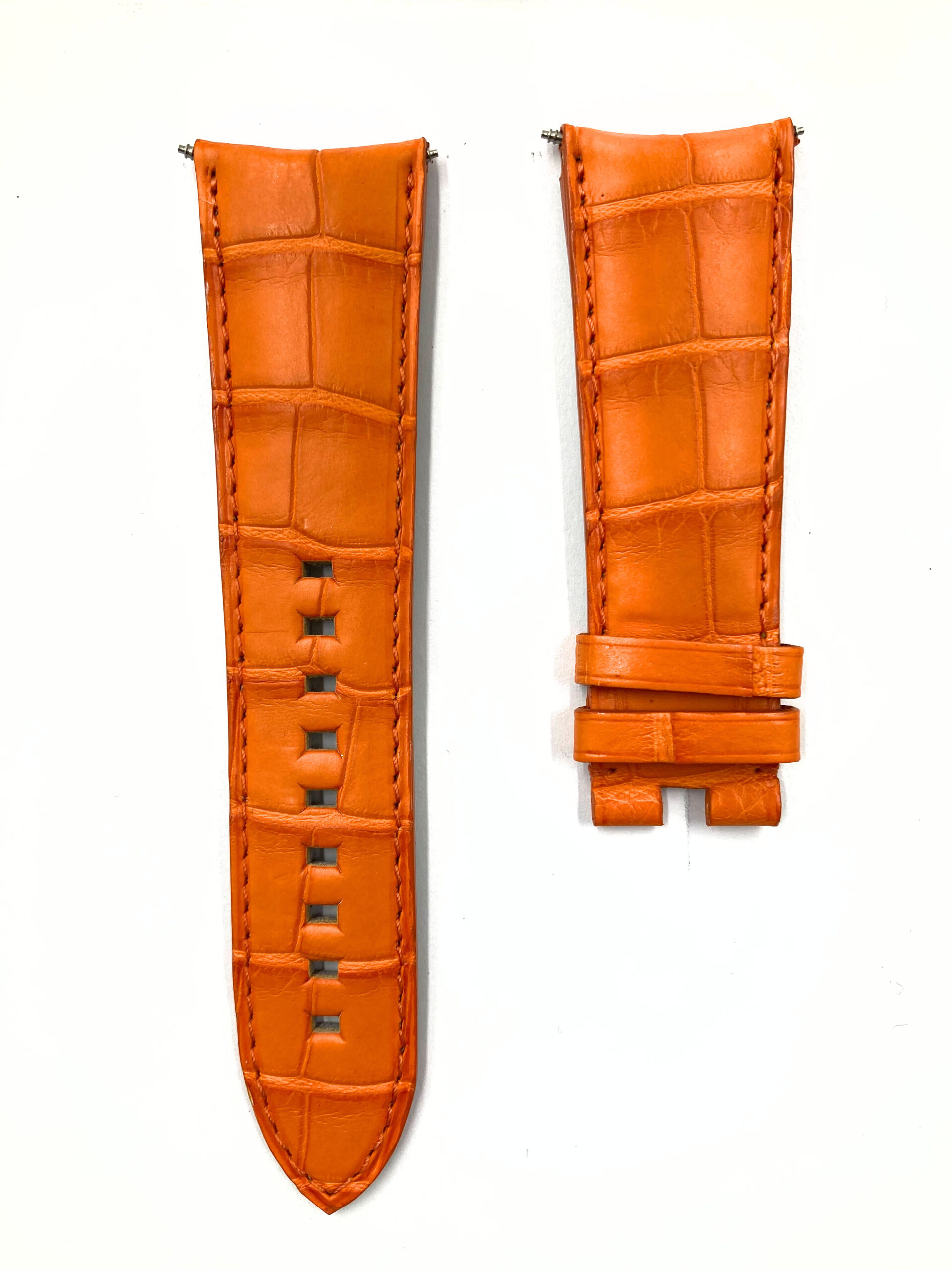
Curved lug straps are different from regular straight lug straps in that the spring bars used are curved. This allows for the leather around the lug area to be curved according to the curvature of the spring bar. A key point to note is that the position of the spring bars relative to the tip of the strap remains the same compared to straight straps. There are no additional inserts used, and because of that, these straps are pretty universal – you can use them on any watch that requires curved lugs. As the curvature of every case will be slightly different, and the curvature of the spring bars can be different too, these straps will be fitted close to the case, but it will not be a 100% flush fit.
There’s another type of strap that is very similar to curved lug straps, and I call them integrated straps. These are straps that are made with a custom made insert fitted at the lug end. The purpose of this insert is to ensure a 100% flush fit with the case of the watch. These inserts are often specific to watch models, and hence integrated straps are often specific to watch models.
There are broadly three categories of watches:
1. “Straight Lug Straps” Watches
These are your typical watches that can be used with straight straps without any issues (rubbing of strap against case etc). For watches in these category, we do not recommend using curved straps. Why can’t curved lug straps be used to reduce the gap between the strap and the watch case? Because it will actually increase the gap. Comparing between straight straps and curved straps, the distance from the spring bars to the tip of the strap remains the same, as there is no additional leather or insert at the lug end. With the curved straps, there is actually a gap caused by the curvature of the spring bar. Since the position of the holes to attach a spring bar on the watch is unchanged, using curved straps on watches that typically require straight straps will result in a larger gap between the strap and the watch case.

I still want to reduce the gap between the strap and the watch case. What can I do?
There are two possible solutions. The first is to find a strap maker that has integrated straps for your specific watch model. But be prepared to spend a large amount for the strap, as you are paying for the R&D cost of developing the custom insert.
The second solution is to order a custom strap, and request for thicker leather around the lugs on your strap. However, with thicker leather, the curvature of the lug will no longer be obvious, so it will not make a difference whether you choose curved or straight lugs.
2. “Curved Lug Straps” Watches
Compared to “Straight Lug Straps” watches, “Curved Lug Straps” watches have two key difference. Firstly, the lugs are typically shorter. Secondly, the holes for attaching spring bars is much closer to the case. Hence, you won’t even be able to attach a straight spring bar to the case, even if you tried. If you own a watch in this category, you must wear it with curved straps.

3. “Short Lug” Watches
The final category of watches are what I call “Short Lug” watches. These are similar to “Straight Lug Straps” watches, but with shorter lug on the watch case. Within this category, there are two sub-categories.
3a. Rectangular-shaped watches. Examples include JLC Reverso, Cartier Santos, Cartier Tank etc.
3b. Regular, round-shaped watches. Examples include some models of Grand Seiko and Rolex.
For category 3a (rectangular-shaped watches with short lugs), we do not recommend curved lug straps just because it will not look good against the straight lines of the case. Standard straight straps should work, but in the event that the lug holes are too close to the case and the strap cannot fit, you will need to get a custom strap and request for extra thin leather around the lugs.
For category 3b (regular, round-shaped watches with short lugs), it is not so straightforward whether you should go with curved or straight spring bars.